
📌 Key Takeaways
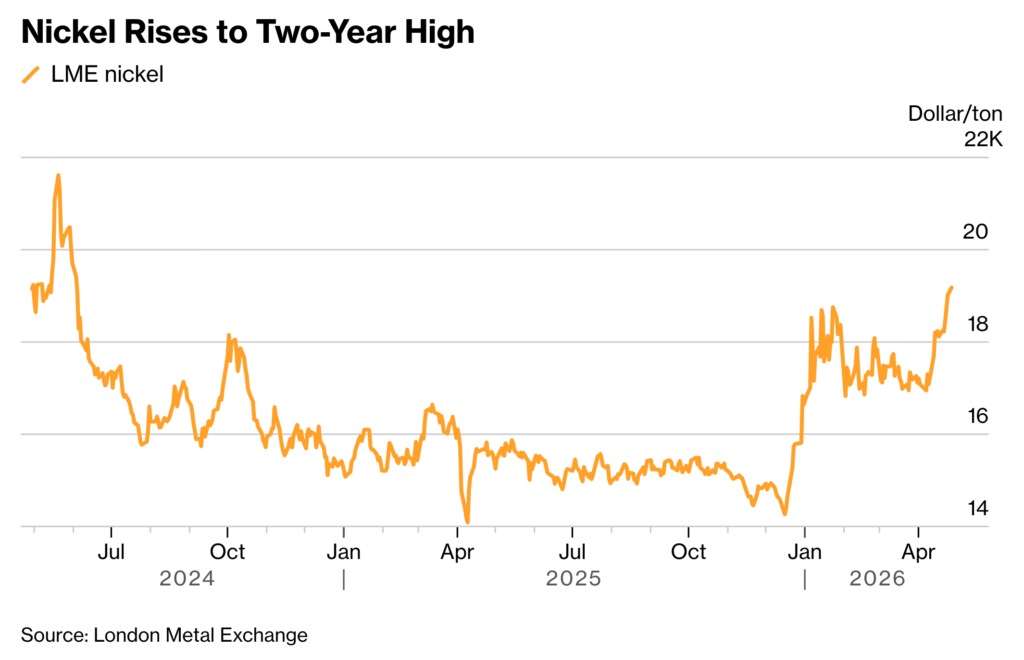
- Nickel rose as much as 1.8% to $19,350/t, the highest intraday level since June 2024.
- Indonesia produced an estimated 2.6 million tonnes of nickel in 2025, about two-thirds of global mine supply.
- Indonesia imports roughly 75% of its sulfur from the Middle East, exposing HPAL nickel plants to Gulf disruption.
- Clean-energy technologies accounted for almost 20% of nickel demand in 2024, with the IEA forecasting that share could rise to 40–50% by 2040.
Nickel prices rose to their highest intraday level since June 2024, touching $19,350 a tonne, as Indonesia’s supply squeeze collided with a sulfur shortage threatening battery-grade nickel production.
For two years, the story was simple: Indonesia flooded the market, Western producers shut mines, and prices fell. The global crisis in the Strait of Hormuz is significantly changing that dynamic.
📈 Why are nickel prices rising?
The immediate trigger is tighter supply from Indonesia.
Indonesia has slashed mining quotas in an attempt to revive prices after years of rapid supply growth. The policy shift matters because Indonesia is no longer just another producer. It is the nickel market.
The U.S. Geological Survey estimates global nickel mine output rose 5% to 3.9 million tonnes in 2025, with Indonesia alone producing 2.6 million tonnes after a 13% increase from 2024.
That dominance turned Indonesia into the price-setter: When Jakarta expanded, nickel fell; when Jakarta tightens, nickel moves.
The shift follows a sharp reversal from the earlier oversupply cycle. Australia’s nickel production fell an estimated 54% in 2025 after companies placed mines into care and maintenance because of low prices, while Philippine output dropped 24% after mine cuts and permitting restrictions.
The nickel rally is not just demand-led. It is policy-led. Indonesia is using supply control to defend price, margins and state revenue.
How important is Indonesia to the nickel market?
Indonesia’s role is hard to overstate.
The country’s share of global nickel supply jumped from 31.5% in 2020 to about 60% in 2024, after its raw ore export ban pulled Chinese-backed refining investment into the country.
That changed the structure of the market.
Nickel supply used to be more diversified across Russia, Canada, Australia, New Caledonia and the Philippines. Today, the marginal tonne increasingly comes from Indonesia.
That gives Jakarta leverage, but also creates a new point of failure.
Indonesia’s nickel boom was built around downstream processing, especially nickel pig iron, matte and mixed hydroxide precipitate, or MHP. MHP is critical for battery supply chains because it can be processed into nickel sulfate for electric vehicle batteries.
But HPAL plants need sulfuric acid. Sulfuric acid needs sulfur. And Indonesia relies heavily on imported sulfur.
Reuters reported that Indonesia’s nickel makers import roughly 75% of their sulfur from the Middle East, while the region accounts for almost a quarter of global sulfur production.
That is where the nickel story now intersects with geopolitics.
🔥 Why does sulfur matter for nickel?
Sulfur is not a headline metal. But for nickel, it is becoming a bottleneck.
Sulfur is used to make sulfuric acid, which is needed in high-pressure acid leaching plants to extract nickel and cobalt from laterite ore. Without reliable acid supply, HPAL output slows.
Reuters reported that sulfur stockpiles at Indonesian HPAL plants averaged only one to two months of consumption, according to sources at Chinese refiners in Indonesia.
Sulfur prices had already climbed to around $500/t before the Gulf disruption, then rose another 10–15%, according to CRU estimates cited by Reuters.
That matters because sulfur was already a major cost item for HPAL.
If sulfur stays expensive, Indonesia’s battery-grade nickel becomes more expensive. If sulfur becomes scarce, production cuts become possible.
⛏️ Is this a real nickel deficit or a short-term squeeze?
The market is not yet structurally tight in the old sense.
The USGS noted that the global primary nickel market has been in surplus since 2022, with the surplus estimated at 98,500 tonnes in 2022, 170,000 tonnes in 2023 and 182,000 tonnes in 2024. Through the first nine months of 2025, the surplus was estimated at 189,000 tonnes, up from 107,000 tonnes in the same period of 2024.
That is why the recent price move matters. Nickel is rallying before the surplus has fully disappeared. The market is repricing the risk that Indonesia’s quota cuts and HPAL input constraints will remove supply faster than expected.
This is less about today’s inventory balance and more about control.
💰 Who benefits from higher nickel prices?
Higher nickel prices benefit producers outside Indonesia first.
The last nickel downturn hit higher-cost producers hard. Australia’s production drop in 2025 showed how quickly Western supply can be forced out when Indonesian supply overwhelms the market.
A sustained price recovery could improve the economics of non-Indonesian nickel sulfide projects in Canada, Australia and other Western jurisdictions.
It could also support companies with cleaner supply chains, lower carbon intensity, or direct exposure to North American and European critical minerals policy.
The U.S. remains import-dependent. USGS data show U.S. primary nickel imports were 100,000 tonnes in 2025, while domestic mine production was only 10,000 tonnes.
That gap matters for defense, stainless steel, batteries and industrial supply chains.
💥 What is the risk for investors?
The risk is that the rally is policy-driven, not demand-driven.
Nickel demand still faces a major battery chemistry shift. AP reported that many Chinese EV makers are moving toward lithium iron phosphate batteries, which use little or no nickel, reducing the metal’s expected role in EV growth.
That does not remove nickel demand. Stainless steel remains the core market. Batteries still matter. The IEA expects total nickel demand to rise from 3.4 million tonnes in 2024 to 4.5–5.4 million tonnes by 2040, with clean-energy technologies rising from almost 20% of demand in 2024 to 40–50% by 2040.
But it does change the investment case.
Nickel is no longer a simple EV growth story. It is a supply-control story, a processing-cost story, and a geopolitical-risk story.
📈 Nickel market data
| Indicator | Latest figure | Why it matters |
|---|---|---|
| Nickel intraday high | $19,350/t | Highest since June 2024 |
| Global mine output, 2025e | 3.9 million tonnes | Market still large and supply-heavy |
| Indonesia output, 2025e | 2.6 million tonnes | Dominant supply source |
| U.S. mine output, 2025e | 10,000 tonnes | Shows U.S. import dependence |
| U.S. primary nickel imports, 2025e | 100,000 tonnes | Strategic supply exposure |
| Indonesia sulfur import reliance | ~75% from Middle East | HPAL bottleneck risk |
🚨 What happens next?
The next phase depends on three signals.
First, whether Indonesia keeps quotas tight. Second, whether sulfur supply disruption persists. Third, whether nickel demand from stainless steel and batteries holds up against weaker EV nickel intensity.
The rally to a two-year high shows the market is already looking past the old surplus narrative. Nickel prices are rising because investors are starting to price a different market: one where Indonesia still dominates supply, but no longer guarantees cheap growth. That makes nickel more strategic, more volatile and more exposed to geopolitics.