

📌 Key Takeaways
- US airlines spent $5.06 billion on jet fuel in March, up 56.4% from February, according to the Bureau of Transportation Statistics.
- Europe is exposed because the Middle East supplies about 375,000 barrels per day, or 75% of Europe’s net jet fuel imports.
- France is preparing airline support measures, including tax and social contribution deferrals, as jet fuel costs rise.
- Goldman Sachs has warned the UK is Europe’s most exposed market because it is the region’s largest net importer of jet fuel and holds no strategic reserves.
US airlines spent $5.06 billion on jet fuel in March, up $1.83 billion from February, after the average fuel cost per gallon jumped 30.9% in one month, according to the Bureau of Transportation Statistics.
That is no longer just an airline cost problem. It is an energy security problem moving through freight costs, tourism, inflation and government policy.
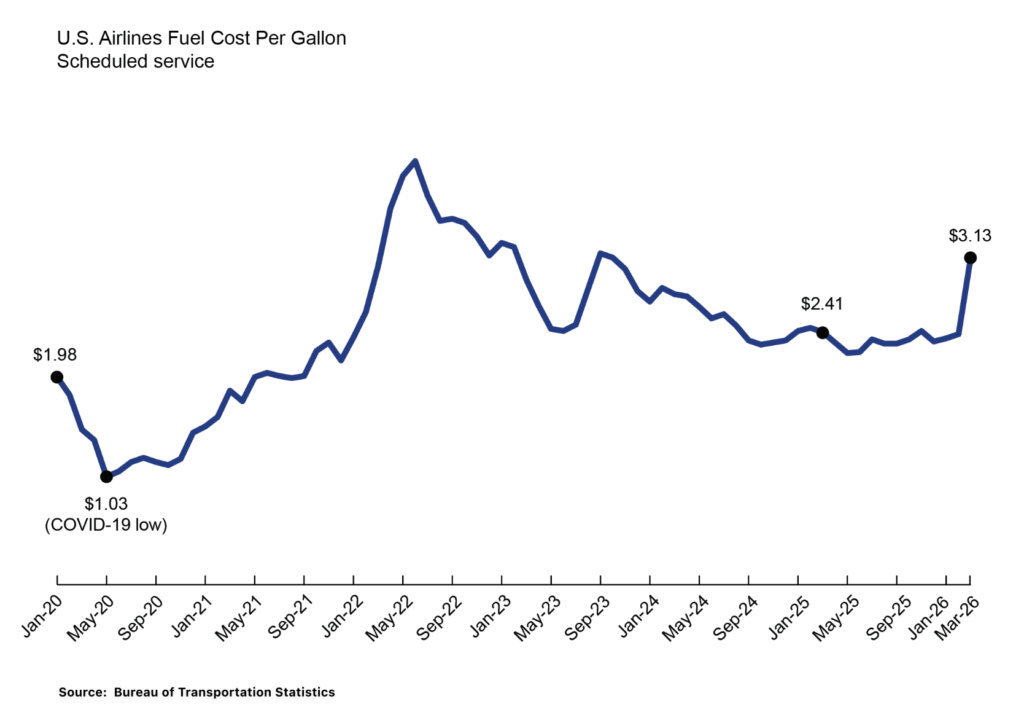
Jet fuel has become one of the most acute pressure points for the global economy in the wider Middle East energy shock. The US-Israeli war with Iran and disruption around the Strait of Hormuz have hit oil and refined fuel markets, with the surge has created the air travel industry’s biggest crisis since Covid.
The first hit is obvious: airlines pay more. The second hit is broader: passengers and freight pay more, weaker carriers cut routes, and governments start preparing support.
🛫 Why is jet fuel suddenly a strategic risk?
A country can have access to crude and still face a shortage of the right fuel in the right place at the right time. Airports need physical supply. Airlines need working inventories. Refiners need the right feedstock and capacity. Europe is finding out how thin that system can get.
Europe has the highest dependency on Middle Eastern jet fuel, with the region supplying nearly 375,000 barrels per day, or 75% of its net jet fuel imports, according to Reuters citing the International Energy Agency.
Goldman Sachs warns Britain is the “most exposed” European market because it is the largest net importer of jet fuel in Europe and holds no strategic reserves, leaving commercial inventories as the main buffer.
That is the market signal: the shortage risk is not only about global supply. It is about import dependence, refinery capacity and storage.
⛽ Jet fuel shock: the numbers
| Indicator | Latest figure | Why it matters |
|---|---|---|
| US airline fuel spend, March 2026 | $5.06bn | Direct hit to airline margins |
| Monthly increase | +56.4% | Shows speed of shock |
| Cost per gallon | $3.09 / gallon | Fare pressure rises |
| US fuel consumption | 1.615bn gallons | Demand remains resilient |
| Europe net jet fuel imports from Middle East | ~375,000 bpd | Supply-chain exposure |
| Middle East share of Europe net imports | ~75% | Concentration risk |
Sources: BTS, Reuters/IEA.
🛩️ How does this hit airlines?
Fuel is one of the largest airline operating costs. When it spikes this fast, airlines have limited choices: raise fares, cut capacity, add surcharges, borrow money or ask governments for relief.
That is already happening.
Alaska Air launched a $500 million debt offering as the Iran war drove up fuel costs, while Reuters reported American Airlines and JetBlue also moved to debt markets to manage the strain.
In France, the government is preparing aid measures for airlines, including deferrals of social security contributions, extended tax payment deadlines and more flexibility on fuel loads.
That is the policy tell. Governments do not prepare airline aid unless the fuel shock is moving from market volatility into economic risk.
⛏️ How does the jet fuel shock hit mining?
Mining is not the first industry people think of when jet fuel prices spike. But it is one of the most exposed.
Many mines operate far from major cities, ports and skilled labour pools. Fly-in, fly-out workforces depend on reliable aviation. Exploration teams depend on charter flights and helicopter support. High-value parts, assay samples, drilling equipment and emergency supplies often move by air when road or rail access is slow, seasonal or unavailable.
That makes jet fuel a hidden input cost across the mining supply chain.
The hit comes at three levels.
First, labour. Remote mines in Canada, Australia, Alaska, northern Europe, Africa and parts of Latin America rely on rotation flights to move workers in and out of site. If airline fuel costs rise sharply, charter contracts, commercial fares and logistics budgets rise with them. US airlines spent $5.06 billion on jet fuel in March, up 56.4% from February, according to the Bureau of Transportation Statistics. That kind of cost inflation does not stay inside the airline sector.
Second, exploration. Junior miners are especially vulnerable because field programmes are often built around tight seasonal windows. Higher aviation costs can push up the price of helicopter-supported drilling, camp resupply, airborne surveys and technical visits. In remote districts, a fuel shock can mean fewer metres drilled, delayed assays and slower discovery timelines.
Third, critical minerals supply. The same projects governments want built fastest — uranium, copper, rare earths, lithium, nickel and graphite — are often in the most logistically difficult places. A jet fuel squeeze raises the cost of operating in exactly the jurisdictions now being promoted as secure supply alternatives to China, Russia or higher-risk routes.
Remote projects with weak infrastructure face higher cost risk. Projects near roads, rail, ports, grid power and established labour pools gain a relative advantage. In a tighter energy market, location becomes part of the grade.
🇪🇺 Why does Europe matter most?
Europe is heading into peak summer travel with a fuel supply chain built around imports.
There is also a strategic angle. Europe is already exposed to jet fuel supply risk because the Middle East supplies about 375,000 barrels per day, or 75% of Europe’s net jet fuel imports, according to Reuters citing the IEA. If that tightness spreads into rationing or sustained price spikes, mining companies will face another reminder that energy security is not just about electricity grids and diesel. It is also about aviation fuel.
Reuters reported in April that Europe’s jet fuel imports loaded from the Middle East were set to dry up because of disruption linked to the Iran war, raising concerns over a supply crunch before summer.
The bloc is scrambling for replacement barrels. Reuters reported Europe has seen record jet fuel inflows from the US and Nigeria, with US flows projected between 149,000 and 200,000 barrels per day and Nigerian exports around 66,000 barrels per day, helped by the Dangote refinery.
That helps. It does not remove the risk.
Replacing a regional supply chain in weeks is expensive. It also shifts pressure into shipping, freight rates, refinery margins and airport-level logistics.
📈 Who loses — and who benefits?
Airlines are the obvious losers. Low-cost carriers are most exposed if they cannot pass through costs without damaging demand. Long-haul carriers face larger absolute fuel bills. Airports can be hit if airlines cut schedules. Consumers face higher fares.
The potential winners are refiners, fuel traders, storage operators, tanker owners and producers with spare product capacity outside the disrupted region.
Nigeria’s Dangote refinery is one example of how new refining capacity can become strategically important fast. Nigerian exports to Europe reached around 66,000 barrels per day, the most on record, as Europe looked for alternatives to Middle Eastern supply.
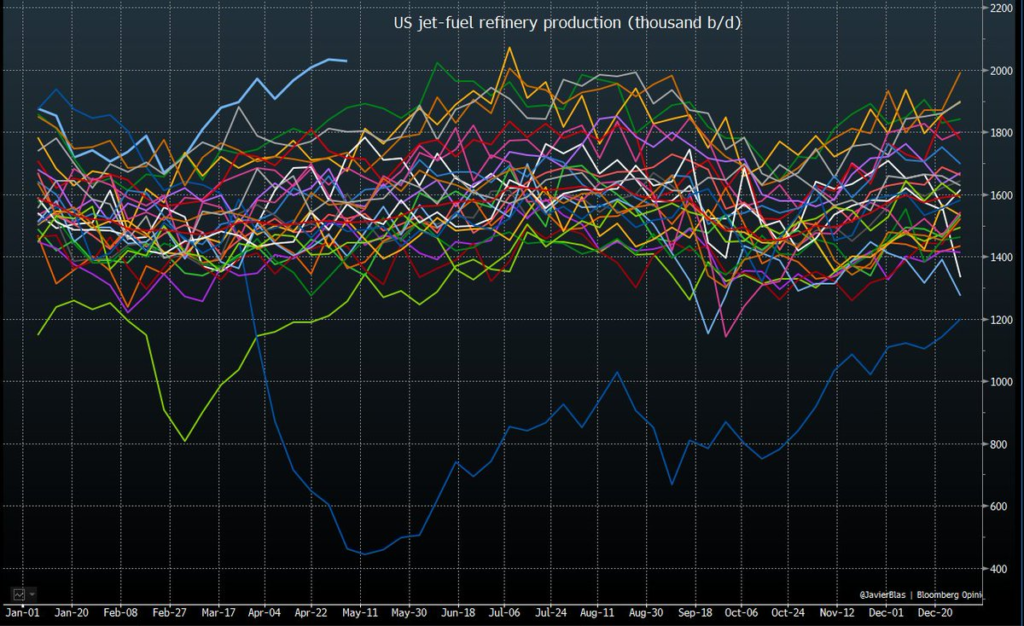
The deeper point is that refining capacity is now part of energy security. Not just oil fields. Not just pipelines. The bottleneck is finished fuel.
Strategic implication:
Jet fuel shortages show why downstream capacity matters. Refining, storage and logistics can become geopolitical assets during supply shocks.
💥 What happens next?
If Middle East flows recover, the crisis may ease. If disruption persists into the European summer, the pressure moves from prices to availability. That is when rationing, route cuts and government intervention become more likely.
Energy security is moving downstream. The market is not only rewarding producers of crude oil. It is repricing the value of refined fuels, storage, shipping routes and spare capacity — and now a macro risk sitting at the intersection of geopolitics, energy markets and consumer inflation.