

President Trump has signed an Executive Order permitting construction of the 211-mile Ambler industrial access road, linking Alaska’s Dalton Highway to the mineral-rich Ambler district in the Brooks Range foothills.
The order also commits $35.6 million in U.S. federal capital to Trilogy Metals, the project operator, giving Washington a direct 10 % ownership stake in one of the few high-grade domestic sources of copper and cobalt.
The White House described the move as “unlocking” Alaska’s critical mineral potential, valued at over $7 billion — including copper, zinc, cobalt and more — part of a broader effort to onshore supply chains essential to defense, electrification, and grid expansion.
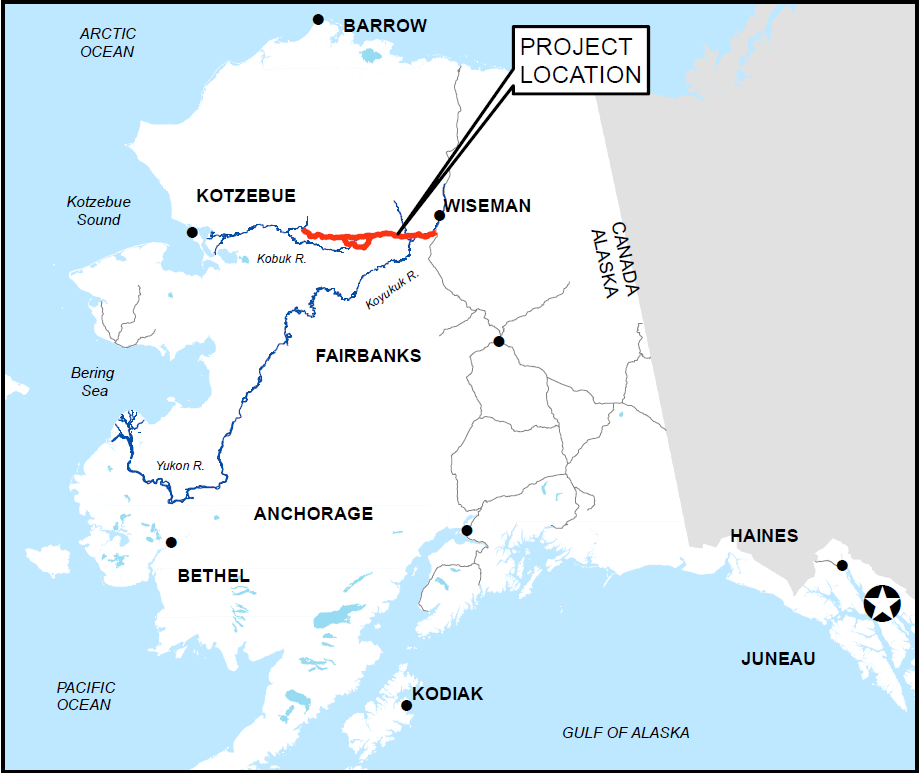
Proposed Ambler Road Project overview map:
📌 Key facts from the White House
- The mineral deposits unlocked by this road include copper, zinc, cobalt, gold, gallium, and germanium — part of an estimated $7 billion copper resource in the region.
- The Ambler road is 211 miles (340 km) connecting the Dalton Highway to the Ambler mining district.
- The federal investment: $35.6 million buys a 10 % stake in Trilogy Metals, plus warrants for an additional 7.5%.
- The road is expected to support ~2,730 construction jobs and generate $1.1 billion in revenue through mining taxes, royalties, and corporate income for Alaska.
- Over 26 miles of the route will pass through the Gates of the Arctic National Park; 11 rivers, thousands of streams lie in its path.
The Ambler road will run through the state’s interior tundra — 26 miles through the Gates of the Arctic National Park, crossing 11 rivers and hundreds of streams. Critics have long warned of the ecological impact. But for the administration, it’s a strategic trade-off: sovereignty over critical inputs outweighs environmental opposition.
According to the Alaska Industrial Development and Export Authority (AIDEA), the Ambler district’s four largest known deposits — Arctic, Bornite, Sunshine, and Smucker — could yield more than $26 billion in metals over their lifetime.
The White House fact sheet puts the accessible value closer to $7 billion in copper alone, with substantial zinc, cobalt, and germanium.
For context:
- The Arctic deposit hosts ~43 million tonnes grading 4.1 % copper-equivalent.
- The Bornite deposit, adjacent to the planned road, contains copper and cobalt resources critical to U.S. battery supply chains.
(Sources: Trilogy Metals; AIDEA; USGS)
Without road access, these deposits remain stranded assets. The Ambler corridor provides the missing link — a transport spine connecting the resource belt to Alaska’s pipeline and port networks.
Strategic Shift: State Capital as Catalyst
The Ambler decision is part of a broader shift in U.S. policy — from subsidizing to co-owning.
Recent Department of Energy moves — including a 5 % stake in Lithium Americas’ Thacker Pass project — established the precedent. The Ambler equity deal extends it overseas, turning Washington into a direct participant in extraction and infrastructure.
In strategic terms, the road’s approval serves three objectives:
- Reduce dependency on China, which processes over 60 % of the world’s copper and 70 % of cobalt.
- Strengthen domestic supply resilience under the Defense Production Act.
- Demonstrate federal-state alignment in mineral development after years of fragmented permitting.
The road hopes to create a direct connection between Alaska’s critical mineral wealth to American manufacturing.
Risks Still on the Road
Despite executive approval, several risks remain:
- Legal challenges are expected from environmental and tribal groups opposing the 2020 Record of Decision.
- Permitting reinstatement by the Bureau of Land Management and National Park Service is still required.
- Cost overruns could test Alaska’s AIDEA and strain public–private financing models.
- Commodity volatility: copper and cobalt prices remain 15–20 % below 2022 highs.
These hurdles mean Ambler is years from production — but the signal is unmistakable: Washington now sees infrastructure as a weapon in the resource race.
The Ambler road approval revives a project shelved under environmental pretexts and reframes it as a matter of strategic independence. For investors, it marks a turning point: the U.S. government is no longer just regulating mining — it’s investing in it.
Whether Ambler becomes a showcase or a cautionary tale will depend on execution. But the direction is clear — America’s new resource strategy runs on roads like this one.