

China Tightens Control Over Rare Earth Exports And Directly Targets U.S. Shipping

-

China’s Ministry of Commerce enacted Announcement No. 18, adding nine medium and heavy rare earth elements and their compounds to a controlled export list, enforcing licensing and customs scrutiny. 

The following minerals, elements, and related materials are now covered under China’s new export-control regime:

  • elements:
    • Holmium (Ho)
    • Erbium (Er)
    • Thulium (Tm)
    • Europium (Eu)
    • Ytterbium (Yb)
  • super-hard materials
  • rare earth equipment + raw and auxilary materials
  • medium and heavy rare earths
  • lithium-battery and graphite anode materials
  • overseas rare earth items
  • rare earth technologies

Within days, Beijing escalated further — announcing additional port fees on U.S. ships starting October 14, effectively expanding its trade coercion beyond minerals.
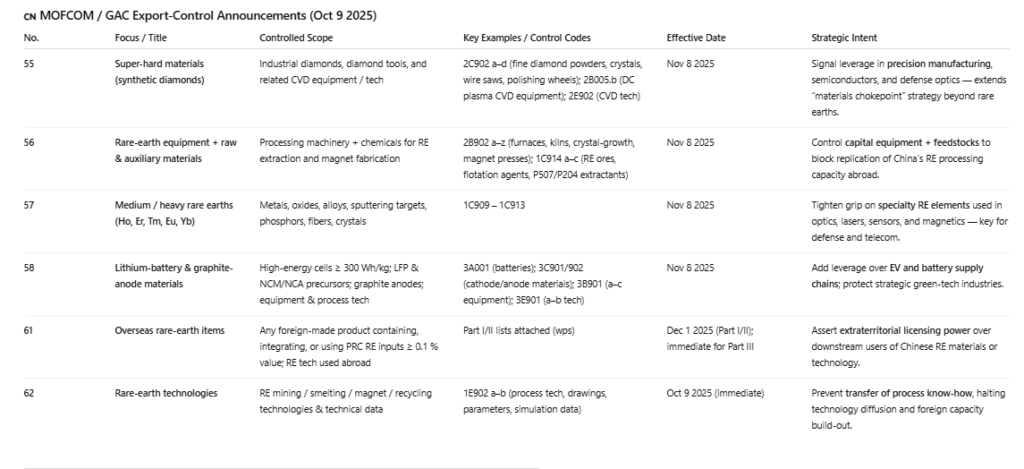
Announcement No. 18 

China now requires exporters to secure dual-use licenses when shipping samarium, gadolinium, terbium, dysprosium, lutetium, scandium, yttrium, and their oxides, alloys, or compounds.  Goods lacking proper classification may be held at customs.

Beijing frames the controls as safeguards for national security and alignment with export control law.  But analysts see a geo-economic motive: reinforcing leverage over global supply chains in critical minerals.

Port Fees: Escalating the Pressure

Starting October 14, U.S.-owned, -flagged, or U.S.-built vessels at Chinese ports will face port fee surcharges.  Chinese-operated vessels docking in U.S. ports will similarly see levies — proposals suggest fees could exceed $1 million per voyage for large container ships. 

Chinese ports will charge 400 yuan (~$56) per net tonnage, rising to 640 yuan in April 2026 and 880 in April 2027.  U.S. ships entering China ports will be charged 400 yuan per net tonnage from October 14. 

This pairing of export licensing and shipping fees signals that China is broadening its toolkit for trade pressure — not just minerals but logistics.

Ripple Effects on Supply Chains

  • Export compliance delays (license processing times stretched to 2–3+ months) are already dragging delivery schedules in semiconductor, automotive, and defense sectors. 
  • The port fees raise the cost baseline for U.S.–China trade, especially for heavy or bulk shipments. For sectors reliant on cross-Pacific shipping (e.g. EV magnets, rare earth alloys), this adds a new expense layer.
  • Select U.S. automaker suppliers reportedly received six-month licenses, possibly as a relief valve to avoid wholesale disruption.

Disclaimer

The Critical Edge is a publisher of financial, commodities, and industry information. Content on this site—including articles, newsletters, podcasts, videos, infographics, and other media—may include sponsored material or advertising. Sponsored placements are clearly identified where applicable, but all editorial decisions remain solely with The Critical Edge.

The information provided is for informational purposes only and should not be considered investment, financial, legal, or professional advice. The Critical Edge is not a registered investment adviser and does not provide personalized or tailored recommendations. Readers should always conduct their own research and consult qualified, licensed advisors before making any investment or financial decisions.

Contributors, editors, directors, employees, or affiliates of The Critical Edge may, from time to time, hold positions in securities, commodities, or sectors mentioned. Readers should assume that such interests may exist.

Some statements on this site may be forward-looking in nature and based on assumptions or expectations that are inherently uncertain. Actual events, results, or market conditions may differ materially. Past performance is not indicative of future results.

While The Critical Edge strives to ensure accuracy, the information provided may be incomplete, delayed, or contain errors. No warranty is made regarding the reliability, accuracy, or completeness of the content. Neither The Critical Edge nor its affiliates accept liability for any direct or consequential loss arising from reliance on the information provided.

By accessing this site or affiliated social media accounts, you agree to this disclaimer and to our terms of use. Unauthorized reproduction or redistribution of content, in any form, is prohibited and may be subject to legal action.

Latest news

Copper Hits Record High as Supply Squeeze Meets AI Demand

Copper has hit another record high, with U.S. futures settling at $6.6495/lb, up 38% from a year ago. And...

Food Inflation Is Back. This Time the Shock Starts Before the Harvest.

US grocery prices rose 0.7% in April, the sharpest monthly increase in nearly four years, while food-at-home prices were...

Copper Tops $14,000 as Supply Squeeze Pushes Market Toward Record High

Copper has hit prices $14,000 a tonne. The metal rallied for an eighth straight session on Wednesday, touching $14,196.50/t on...

Jet Fuel Shortage: Airlines and Miners Face New Energy Shock

📌 Key Takeaways US airlines spent $5.06 billion on jet fuel in March, up 56.4% from February, according to the...

Big Funds Pour Billions Into Mining Supercycle Bet

📌 Key Takeaways Mining ETF assets more than doubled to $87.4 billion by March 2026, according to Reuters. Investors put $8.24...

Nickel Prices Hit Two-Year High as Indonesia Tightens Supply

📌 Key Takeaways Nickel rose as much as 1.8% to $19,350/t, the highest intraday level since June 2024.   Indonesia produced...