
China’s Crude Oil Stockpiling Pushes Past 1.4 Billion Barrels

-

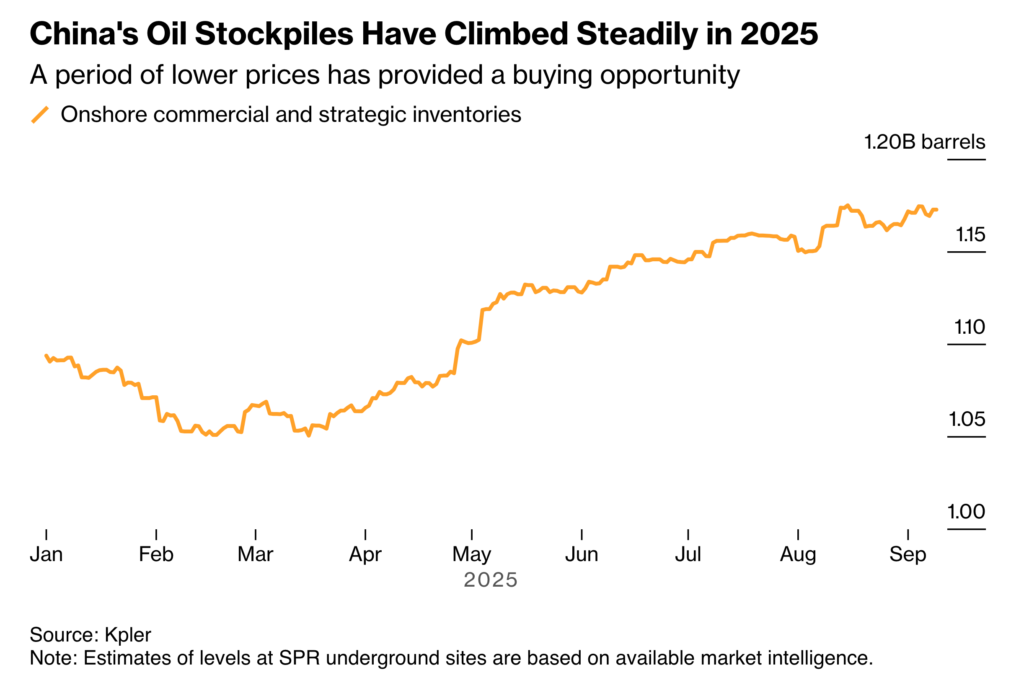
China has built one of the largest crude stockpiles in the world, with onshore inventories now estimated at around 1.4 billion barrels, including some 355 million barrels held in its strategic petroleum reserve (SPR).

The scale of accumulation is striking: in the first eight months of 2025, surplus crude—imports plus domestic output minus refinery runs—averaged nearly 1 million barrels a day, with August alone topping that level. China’s surplus crude (imports + domestic output minus refinery runs) has averaged ~990,000 barrels per day (bpd) in the first eight months of 2025. 
🇨🇳 Why is China stockpiling so much oil?

  1. Price Window: China’s stockpiling comes against a backdrop of softer oil prices and rising geopolitical risks. Benchmark Brent fell from above $80 a barrel in January to lows under $60 by May, creating a buying window that Beijing moved quickly to exploit. At the same time, refinery throughput has lagged import flows, leaving excess barrels that can only be diverted into storage. China is taking advantage. 
  2. Refinery Constraints Refinery throughput is increasing but still can’t keep up with inflows. That creates a bottleneck—crude comes in faster than it’s processed, so it gets stored. 
  3. Strategic and Geopolitical Hedging Strategic motives also loom large. Tensions in the Middle East, sanctions on Russian and Iranian shipments, and a more fragmented global supply chain have all heightened China’s desire to expand its energy buffer. Analysts at LSEG expect the country’s SPR build to continue well into the first half of 2026.

🛢️ What does this mean for oil markets?

For oil markets, the implications are twofold. First, the accumulation acts as a hidden price support. Even when demand signals are weak, Chinese buying absorbs supply and reduces downward pressure on benchmarks. Second, the opacity of China’s reserve data adds volatility. Traders have no clear line of sight into how much crude is being absorbed, or when Beijing might shift from building inventories to drawing them down.

That lack of transparency is already distorting markets. Discounts on sanctioned barrels—particularly from Iran—are widening as storage tanks in key hubs such as Shandong fill up, while refiners weigh quotas and logistics bottlenecks. The uncertainty feeds into forecasts, with analysts forced to hedge their supply-demand balances around one of the biggest blind spots in global energy.

📌 Conclusion

Bottom line: China has already put away a huge barrel count, with surplus crude flows of ~1 mbpd sustaining the build. For global oil markets, the accumulation acts like a hidden buffer—supporting prices, increasing uncertainty, and altering where value can be derived (storage, transport, flexibility).

Disclaimer

The Critical Edge is a publisher of financial, commodities, and industry information. Content on this site—including articles, newsletters, podcasts, videos, infographics, and other media—may include sponsored material or advertising. Sponsored placements are clearly identified where applicable, but all editorial decisions remain solely with The Critical Edge.

The information provided is for informational purposes only and should not be considered investment, financial, legal, or professional advice. The Critical Edge is not a registered investment adviser and does not provide personalized or tailored recommendations. Readers should always conduct their own research and consult qualified, licensed advisors before making any investment or financial decisions.

Contributors, editors, directors, employees, or affiliates of The Critical Edge may, from time to time, hold positions in securities, commodities, or sectors mentioned. Readers should assume that such interests may exist.

Some statements on this site may be forward-looking in nature and based on assumptions or expectations that are inherently uncertain. Actual events, results, or market conditions may differ materially. Past performance is not indicative of future results.

While The Critical Edge strives to ensure accuracy, the information provided may be incomplete, delayed, or contain errors. No warranty is made regarding the reliability, accuracy, or completeness of the content. Neither The Critical Edge nor its affiliates accept liability for any direct or consequential loss arising from reliance on the information provided.

By accessing this site or affiliated social media accounts, you agree to this disclaimer and to our terms of use. Unauthorized reproduction or redistribution of content, in any form, is prohibited and may be subject to legal action.

Latest news

Copper Hits Record High as Supply Squeeze Meets AI Demand

Copper has hit another record high, with U.S. futures settling at $6.6495/lb, up 38% from a year ago. And...

Food Inflation Is Back. This Time the Shock Starts Before the Harvest.

US grocery prices rose 0.7% in April, the sharpest monthly increase in nearly four years, while food-at-home prices were...

Copper Tops $14,000 as Supply Squeeze Pushes Market Toward Record High

Copper has hit prices $14,000 a tonne. The metal rallied for an eighth straight session on Wednesday, touching $14,196.50/t on...

Jet Fuel Shortage: Airlines and Miners Face New Energy Shock

📌 Key Takeaways US airlines spent $5.06 billion on jet fuel in March, up 56.4% from February, according to the...

Big Funds Pour Billions Into Mining Supercycle Bet

📌 Key Takeaways Mining ETF assets more than doubled to $87.4 billion by March 2026, according to Reuters. Investors put $8.24...

Nickel Prices Hit Two-Year High as Indonesia Tightens Supply

📌 Key Takeaways Nickel rose as much as 1.8% to $19,350/t, the highest intraday level since June 2024.   Indonesia produced...