

📌 Key Takeaways
- US data centers are becoming one of the fastest-growing sources of electricity demand, driven by AI and cloud computing.
- Donald Trump wants tech companies to pay directly for new power generation and grid stability measures tied to data center growth.
- The policy shifts costs toward hyperscalers and could accelerate investment in gas, nuclear, and grid-critical minerals.
- Power prices, permitting timelines, and mineral supply chains are emerging as binding constraints on AI growth.
Donald Trump plans to force US tech companies to pay for new power generation and grid capacity required by AI data centers, marking a shift in how the exploding electricity demand from artificial intelligence is financed.
US data centers already consume roughly 4% of total US electricity, a share expected to double to 7–8% by the end of the decade as AI workloads scale, according to US government and industry estimates. That surge is now colliding with a power grid never designed for hyperscale computing, as well as costs for households.
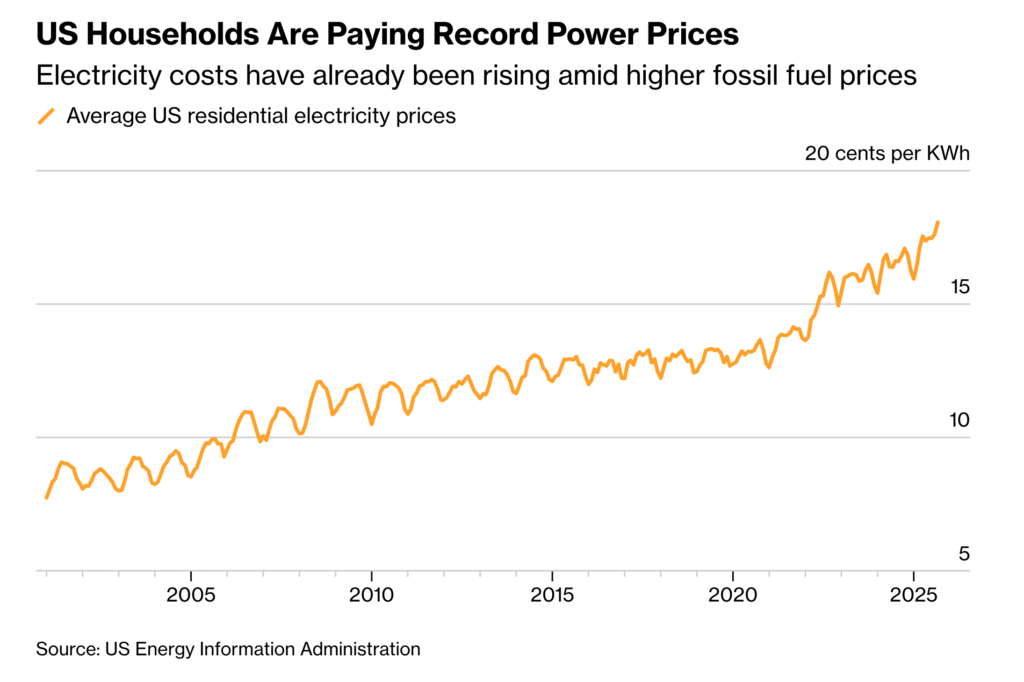
Donald Trump is moving to force tech companies to shoulder those costs directly. The former president plans to direct PJM Interconnection, the largest US grid operator, to hold an emergency power auction aimed at stabilising electricity supply and pricing in regions overwhelmed by data center demand, according to Bloomberg.
Why data centers are breaking the grid
The electricity footprint of AI is not marginal. A single large AI-focused data center can draw as much power as 80,000 to 100,000 homes. In Northern Virginia and parts of the Midwest, data centers are already the dominant source of incremental power demand, overwhelming transmission planning assumptions. PJM has warned that new connections from data centers are arriving faster than new generation capacity, creating a structural risk of price spikes and reliability shortfalls.
This imbalance is already showing up in prices. US wholesale electricity prices in some data-center-heavy regions have surged as utilities scramble to secure capacity.
Power grid reality check
- Data centers are among the least flexible loads on the grid.
- AI workloads run 24/7 and cannot be curtailed easily.
- Grid upgrades typically take 5–10 years, while data centers can be built in under two.
Sources: Bloomberg, FT, AP News
Who pays matters for markets
Trump’s approach represents a sharp shift in US energy policy logic. Historically, grid expansion costs are socialised across ratepayers. Under this proposal, hyperscalers would be required to contract generation directly, fund grid upgrades, or underwrite emergency capacity auctions.
That changes incentives.
Natural gas plants, small modular nuclear reactors, and dedicated on-site generation become more attractive if tech firms are forced to lock in long-term power supply. The FT reports that utilities are already dusting off delayed gas projects as the only scalable option that can be built quickly enough to meet AI demand.
For investors, this reframes AI as an energy-intensive industrial activity, not just a software story.
The hidden mineral bill behind AI power
Electricity is only part of the equation. Grid expansion and new generation are mineral-heavy.
Gas turbines require nickel-based superalloys. Transmission lines are copper-intensive. Substations rely on steel, aluminium, and rare earth magnets. Nuclear projects pull uranium, zirconium, and specialty steels into focus.
As the US accelerates power build-out to support AI, demand pressure shifts upstream into mining and processing. This is where geopolitics re-enters the picture. Many of the minerals underpinning grid and power infrastructure remain China-centric, from rare earths to graphite.
Why this matters now
The next phase of the AI boom will not be decided by chips alone. It will be decided by who controls electricity and minerals — in other words: energy.
And Trump wants Silicon Valley to start paying.