

📌 Key Takeaways
- Australia and the U.S. are negotiating a US$777 million rare earth financing deal
- China controls 70% of rare earth mining and 90% of processing
- Move accelerates Australia’s critical minerals pivot and aligns with U.S. industrial policy
Australia and the U.S. plan a $777M rare earth fund to cut China supply risk and secure critical minerals for defense and EV industries, according to The Age.
Australia is in discussions with the United States to establish a US$777 million rare earth financing facility designed to fast-track projects that bypass Chinese processing control. The bilateral fund would mark one of the largest strategic investments yet in critical mineral supply chains among Western allies.
The facility would operate alongside Australia’s existing A$4 billion (US$2.6 billion) Critical Minerals Facility, but focus exclusively on rare earth extraction, separation and refining, with priority on neodymium and praseodymium (NdPr) oxides used in high-performance permanent magnets.
Why now
The deal comes as the U.S. grows increasingly exposed to Chinese export leverage in critical materials. Beijing currently controls 70% of global rare earth production and 90% of processing capacity.
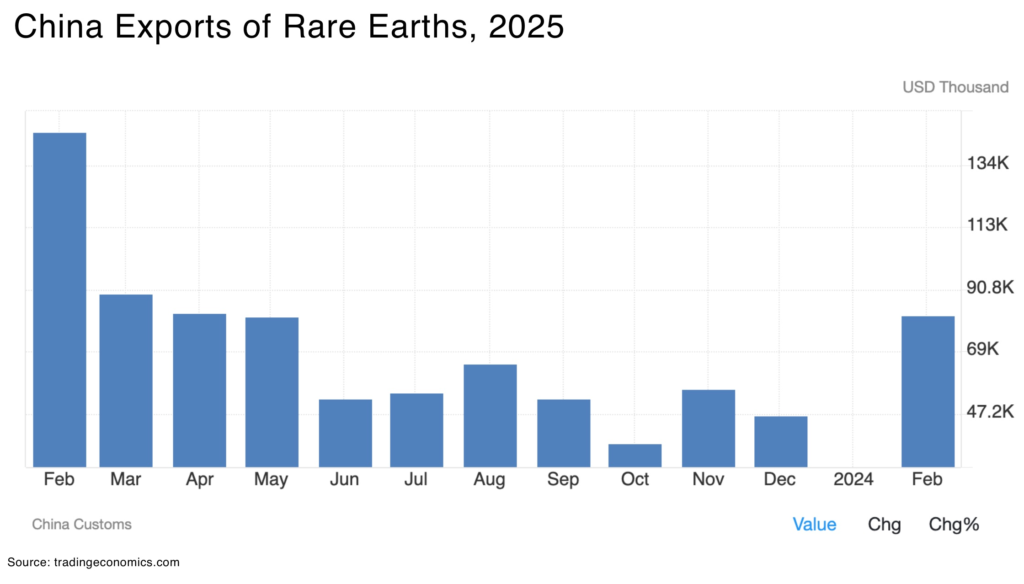
In May 2025, U.S. imports of rare earth magnets from China fell 93.3% month-on-month after Beijing tightened controls on dual-use materials for defense. And, in October 2025, China threatened to tighten export restrictions further as leverage ahead of a meeting between presidents Xi and Trump.
Rare Earth exports from China in September hit 4,000.3 tonnes vs 5,791.8 tonnes in August.
Rare earth magnets are essential to missile guidance systems, F-35 fighter jets, drones, satellites, hypersonic platforms, EV motors and wind turbines. The U.S. Department of Defense lists NdPr as a national security material and has invoked the Defense Production Act to support domestic capacity since 2023.
Washington now sees allied supply—particularly from Australia—as essential to industrial security.
What the fund will do
The proposed facility will blend government loans, guarantees and potentially equity stakes to underwrite rare earth separation plants, long-term refining hubs and magnet precursor production inside Australia. Financing is expected to target companies already in advanced development or expansion.
The U.S. Development Finance Corporation (DFC) and the Pentagon’s Title III program are expected to co-structure terms alongside Australia’s Export Finance Agency (EFA).
Strategic context: Australia’s mining pivot
Canberra has spent the past three years reengineering its resources strategy away from bulk commodities like iron ore and coal toward critical minerals for the energy and defense sectors. The move includes a stock pile and possible price floor to support miners and possibly offer shares in any such stockpiles to allies such as the UK and US.
What comes next
Negotiations are ongoing and a final announcement is expected in early 2026. The deal will form part of a broader AUKUS-aligned supply chain strategy, extending Western control across defense-critical metals beyond rare earths, including titanium, nickel, and graphite.
For investors, the signal is clear: Western rare earth supply will now be state-backed.