

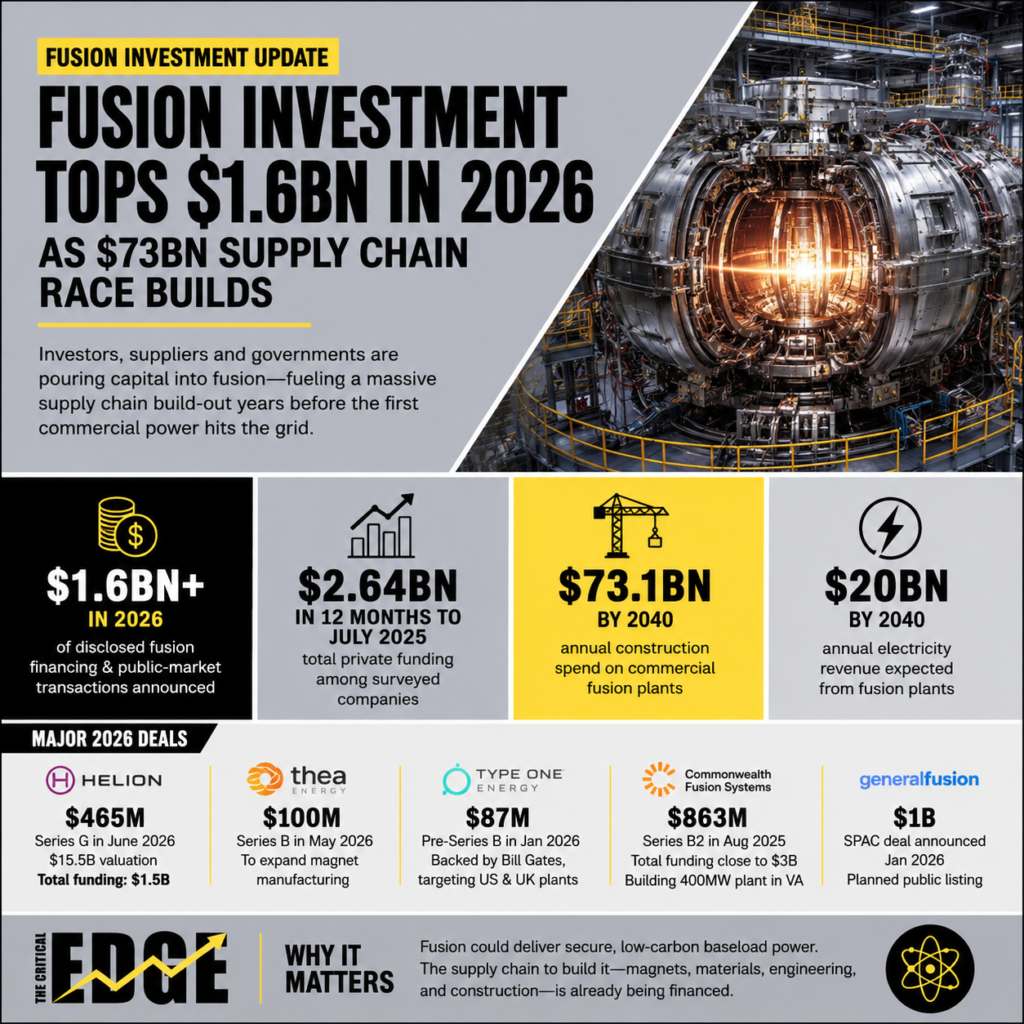
At least $1.6 billion of disclosed fusion investment, financing and public-market transactions has been announced in 2026, as investors, suppliers and governments position for a technology still years from commercial power generation but already pulling capital into manufacturing, magnets, engineering and construction.
The latest funding comes after fusion companies raised $2.64 billion, in the 12 months to July 2025, taking total private fusion funding among surveyed companies to almost $9.8 billion, according to the Fusion Industry Association.
The money is moving because the energy market has changed.
Power demand is rising from AI data centres, electrification and industrial reshoring. Governments are looking for secure, low-carbon baseload electricity. Investors are betting fusion could become part of that system if companies can prove the technology can be built, licensed and repeated at commercial scale.
The near-term opportunity is not just electricity sales. It is the industrial build-out needed to get there.
Consultancy Helixos estimates annual construction spending on commercial fusion plants could reach $73.1 billion by 2040, according to the Financial Times. That would be more than three times the $20 billion of annual electricity revenue expected from those plants at that point.
That is why fusion supply chain suppliers are starting to spend before commercial plants exist.
Japan’s Fujikura is investing $72 million to expand production of superconducting magnet materials, a key component for fusion machines that use powerful magnetic fields to confine plasma. Aecom has invested in Type One Energy, a Bill Gates-backed fusion company developing plants in the US and UK.
The UK is also pushing ahead with its government-backed STEP fusion programme, with Kier Infrastructure and Nuvia among the companies already involved.
The biggest recent financing came from Helion Energy, backed by Sam Altman. The company raised $465 million in June at a $15.5 billion post-money valuation, taking total funding to $1.5 billion. Helion said the money will expand US fusion manufacturing capacity and accelerate commercial deployment.
Thea Energy raised $100 million in May to expand magnet manufacturing capacity and accelerate construction of its integrated fusion system. Type One Energy reportedly raised $87 million in January ahead of a larger Series B round. General Fusion announced a planned public listing through a SPAC deal valuing the company at about $1 billion.
Commonwealth Fusion Systems remains one of the best-funded private companies in the sector. It raised $863 million in August 2025, taking total funding to close to $3 billion. The company said the money would help complete SPARC, its fusion demonstration machine, and advance its first ARC power plant in Virginia.
Commercial fusion still has major unresolved problems.
No company has delivered power to the grid from a commercial fusion plant. Developers still need to prove they can sustain reactions, protect reactor components, handle fuel, secure permits, finance large projects and build plants repeatedly at a cost power markets can absorb.
But investment is no longer waiting for a finished reactor.
Capital is moving into superconducting magnets, high-temperature superconductors, specialist steels, tungsten, lithium systems, tritium handling, power electronics, precision manufacturing and construction services.
For critical minerals and advanced materials, that is the signal.
Fusion may take years to generate commercial electricity. But the supply chain required to build fusion power plants is already being financed.