

📌 Key Takeaways
- U.S. crude exports jumped to 5.2 million barrels per day in the week to April 10, the highest in seven months, as buyers in Europe and Asia scrambled to replace disrupted Middle East barrels.
- Net U.S. crude imports fell to just 66,000 barrels per day, but that does not mean the U.S. has become structurally self-sufficient in crude.
- Around 80 supertankers are now headed for the U.S. Gulf Coast to load crude in coming months, showing how hard the global market is pulling on American barrels.
US crude exports surged to 5.2 million barrels a day on April 10, the highest in seven months — but net crude imports collapsed to just 66,000 barrels per day, the lowest in records going back to 1943. Approximately 80 supertankers are now headed to the Gulf of Mexico to load crude in the coming months.
The Iran war is doing something the “energy dominance” narrative rarely admits clearly: it is turning the U.S. into the emergency barrel of last resort, but not into an unlimited one.
🛢️ Why are U.S. crude exports rising so fast?
The answer is price and arbitrage. The EIA’s April Short-Term Energy Outlook says the Brent-WTI spread peaks at $15 a barrel in April as Middle East disruptions bite and shipping costs rise. Brent is more exposed to global disruption than inland U.S. crude, so overseas buyers can still justify paying up for American barrels even after freight. The EIA also said Brent averaged $103 a barrel in March and could average $115 a barrel in the second quarter before easing later this year.
That spread is the mechanism turning U.S. shale into a geopolitical export machine.
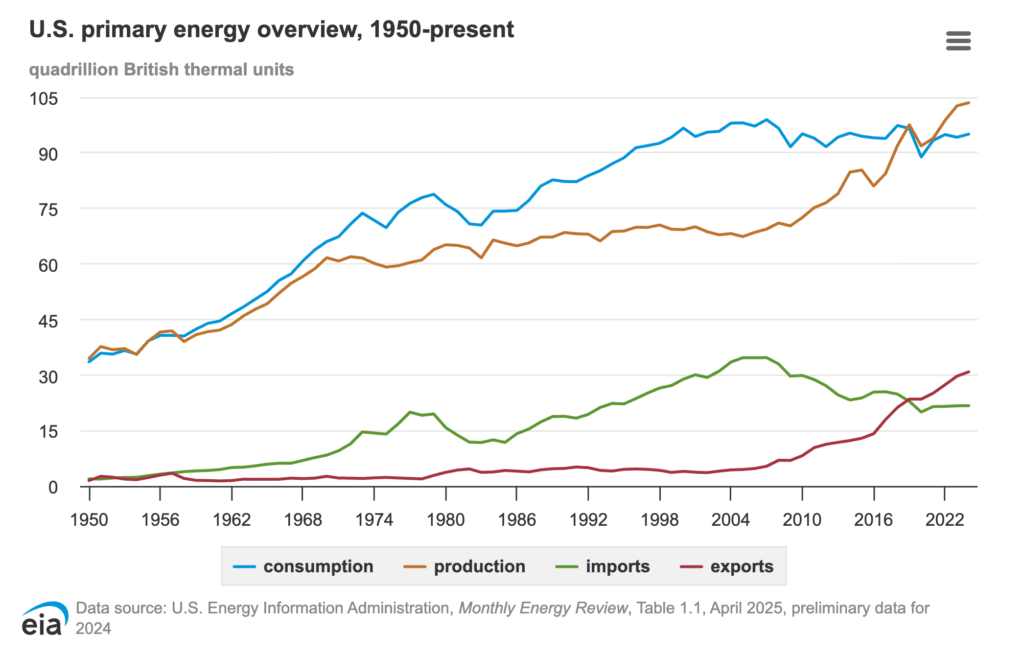
💰 Is the U.S. really a net oil exporter now?
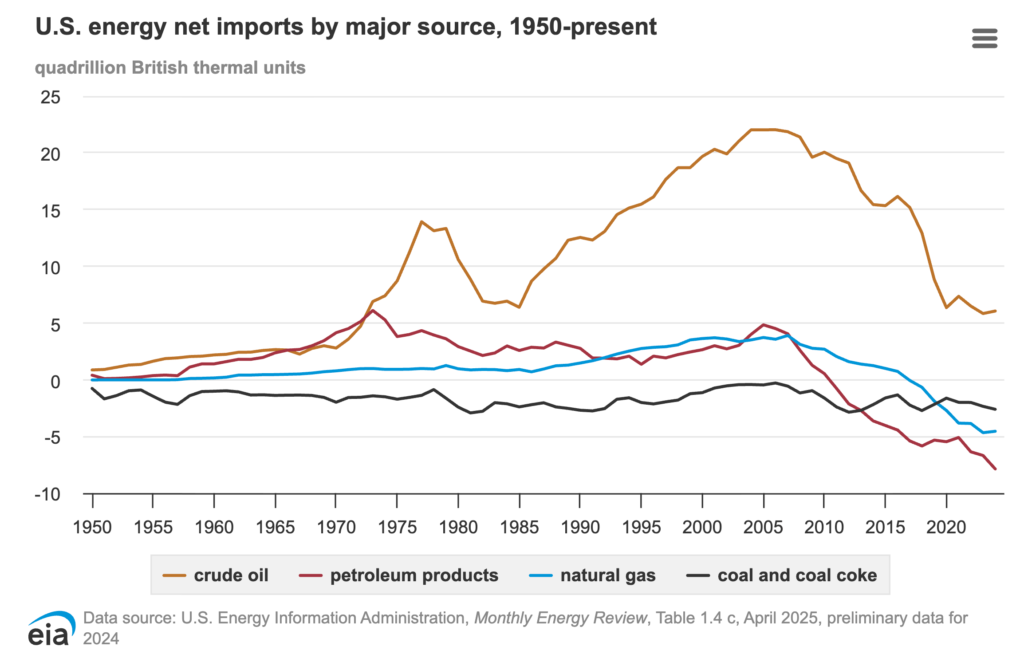
The United States remained a net crude oil importer in 2024, even though it is a major exporter of crude and refined products. The U.S. imported 6.2 million barrels per day of crude in 2025, but 8% of that came from the Middle East Gulf.
The key number is Canada: U.S. crude imports are still dominated by nearby Western Hemisphere supply, especially Canadian barrels that fit refinery needs better than much of the light sweet shale crude the U.S. exports.
That is the structural catch. America can export a lot more crude in a crisis, but it still imports large volumes because its refinery system was built around a different crude slate. That means the marginal answer to lost Middle East supply is not just “more U.S. shale.” In part, it is also more Canadian crude flowing south and more reshuffling inside North America.
🏗️ What caps further upside?
First, logistics. The latest Weekly Petroleum Status Report shows U.S. crude imports at 5.3 million barrels per day in the week ending April 10, almost level with the 5.2 million barrels per day export figure cited by Reuters. The same report shows refineries still taking in about 16.0 million barrels per day of crude. That is a reminder that the domestic system is still enormous, still hungry, and still not built to live on exportable light oil alone.
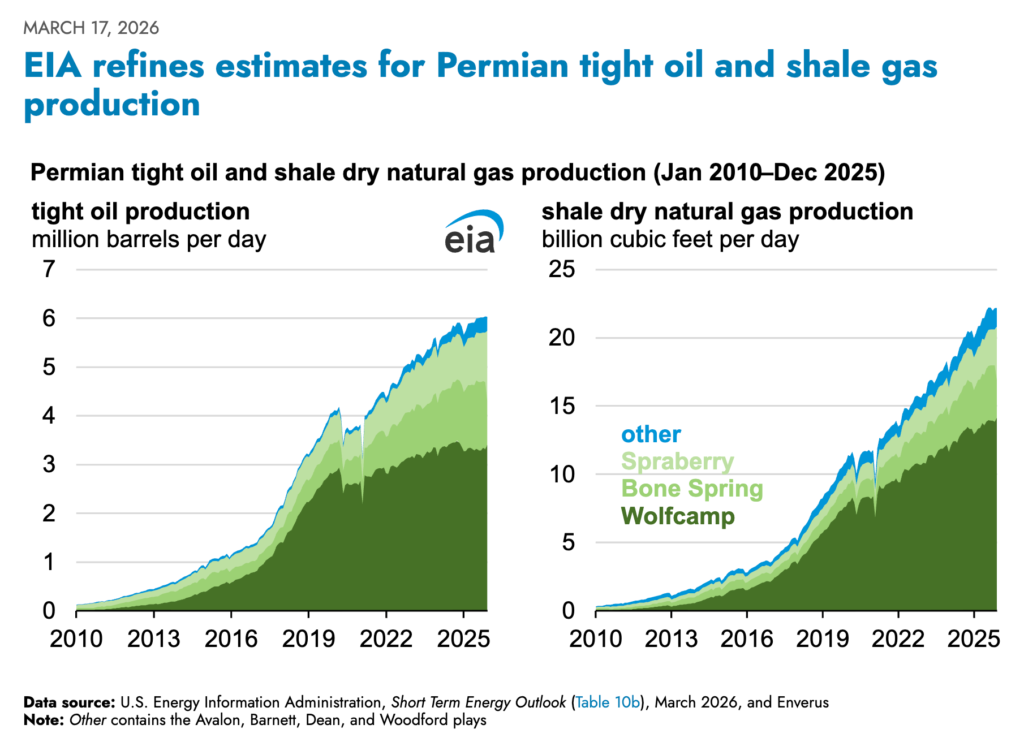
Second, drilling momentum across the USA and shale is not screaming “surge” with Baker Hughes reporting that in the week to April 2, the total U.S. oil and gas rig count was 548, still 7.1% below a year earlier, with oil rigs at 411, suggesting the industry is not behaving as if it has endless cheap spare capacity ready to flood the market.
The EIA said U.S. crude output hit a record 13.6 million barrels per day in 2025, up 3% year on year. That is a huge base. But a huge base is not the same thing as a huge cushion.
The market signal
The market is telling investors two things at once.
First, U.S. crude is now the default substitute barrel when the Middle East breaks. Second, that substitute barrel is finite, more expensive at the margin, and tied to infrastructure, freight and refinery bottlenecks. In other words, the Iran war is not proving that America can replace the Gulf. It is proving how valuable U.S. barrels become when the Gulf cannot be trusted.