

Nickel Supply Shock Returns as Indonesia Threatens to Tighten the Tap

-

📌 Key Takeaways

  • Nickel prices hit a nine-month high as Indonesia signals material supply cuts and delays mine approvals.
  • Indonesia controls ~50% of global nickel supply, giving policy shifts outsized market impact.
  • EV and stainless steel supply chains face renewed volatility just as inventories begin to tighten.

Nickel prices surged to a nine-month high in late December after Indonesia signaled fresh supply discipline, reversing years of unchecked output growth that crushed prices and margins. The catalyst: Vale Indonesia halted part of its nickel mining after authorities delayed approval of its 2026 work plan, underscoring how regulatory risk is back in play for the world’s dominant producer.

Bloomberg reported the halt removed near-term supply from an already tightening market, adding to price momentum as traders reassessed Indonesian policy risk.
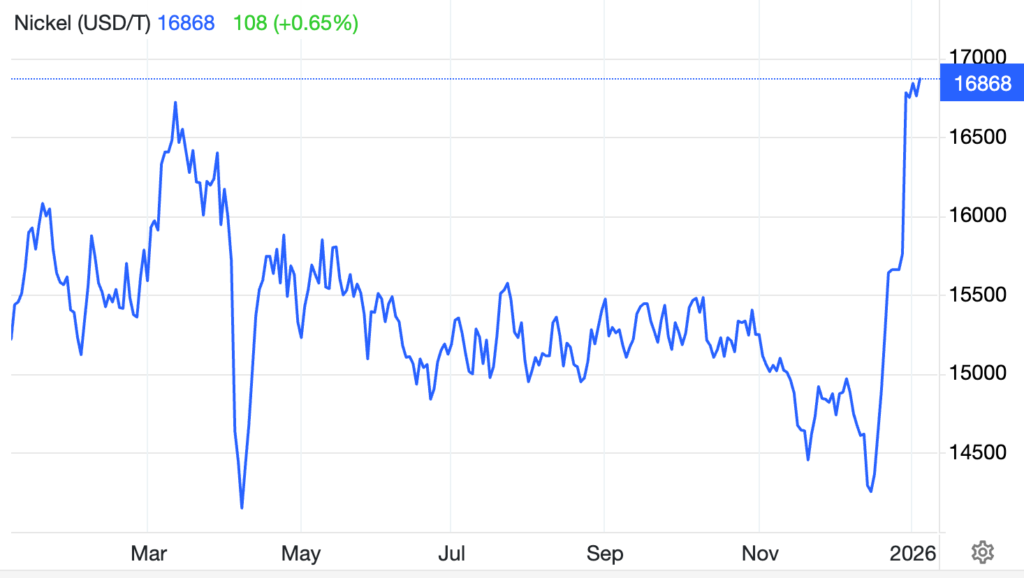
📉 Market context: Nickel had been one of the worst-performing battery metals of 2024–25 after Indonesia’s rapid capacity build flooded the market. That cycle is now turning.

Indonesia pivots from volume to value

Indonesia accounts for more than half of global mined nickel supply, a position built through aggressive investment in laterite mining and smelting. But Jakarta is now openly discussing output controls, tighter work-plan approvals, and policy shifts aimed at price stabilization and fiscal discipline.

S&P Global notes policymakers are weighing production cuts and stricter oversight to curb oversupply and protect state revenues, even at the risk of short-term volume losses.

These signals were enough to push nickel prices sharply higher, with traders pricing in reduced ore availability and slower growth in nickel pig iron and matte output.

Why this matters for EVs and stainless steel

Nickel demand remains structurally tied to two pillars: stainless steel and electric-vehicle batteries. While EV demand growth slowed in 2024, forecasts still show rising nickel intensity in high-nickel cathodes over the medium term. Any sustained Indonesian supply restraint tightens the forward balance just as inventories normalize from record highs.

For EV manufacturers and battery makers, Indonesia’s pivot raises cost uncertainty and reinforces the strategic risk of over-reliance on a single jurisdiction. For miners outside Indonesia, it reopens the investment case that was effectively closed during the oversupply phase.

The bigger picture: policy risk is back for nickel

Indonesia’s nickel strategy is evolving from expansion at any cost to managed scarcity. The Vale Indonesia halt is a reminder that regulatory approval — not geology — is now the binding constraint. For investors, the signal is clear: nickel is no longer just a demand story. It is a policy-driven market again, with Jakarta holding the lever.

If output cuts move from rhetoric to enforcement, the recent price spike may prove less a short-covering rally — and more the first chapter of a tighter nickel cycle.

Disclaimer

The Critical Edge is a publisher of financial, commodities, and industry information. Content on this site—including articles, newsletters, podcasts, videos, infographics, and other media—may include sponsored material or advertising. Sponsored placements are clearly identified where applicable, but all editorial decisions remain solely with The Critical Edge.

The information provided is for informational purposes only and should not be considered investment, financial, legal, or professional advice. The Critical Edge is not a registered investment adviser and does not provide personalized or tailored recommendations. Readers should always conduct their own research and consult qualified, licensed advisors before making any investment or financial decisions.

Contributors, editors, directors, employees, or affiliates of The Critical Edge may, from time to time, hold positions in securities, commodities, or sectors mentioned. Readers should assume that such interests may exist.

Some statements on this site may be forward-looking in nature and based on assumptions or expectations that are inherently uncertain. Actual events, results, or market conditions may differ materially. Past performance is not indicative of future results.

While The Critical Edge strives to ensure accuracy, the information provided may be incomplete, delayed, or contain errors. No warranty is made regarding the reliability, accuracy, or completeness of the content. Neither The Critical Edge nor its affiliates accept liability for any direct or consequential loss arising from reliance on the information provided.

By accessing this site or affiliated social media accounts, you agree to this disclaimer and to our terms of use. Unauthorized reproduction or redistribution of content, in any form, is prohibited and may be subject to legal action.

Latest news

Copper Hits Record High as Supply Squeeze Meets AI Demand

Copper has hit another record high, with U.S. futures settling at $6.6495/lb, up 38% from a year ago. And...

Food Inflation Is Back. This Time the Shock Starts Before the Harvest.

US grocery prices rose 0.7% in April, the sharpest monthly increase in nearly four years, while food-at-home prices were...

Copper Tops $14,000 as Supply Squeeze Pushes Market Toward Record High

Copper has hit prices $14,000 a tonne. The metal rallied for an eighth straight session on Wednesday, touching $14,196.50/t on...

Jet Fuel Shortage: Airlines and Miners Face New Energy Shock

📌 Key Takeaways US airlines spent $5.06 billion on jet fuel in March, up 56.4% from February, according to the...

Big Funds Pour Billions Into Mining Supercycle Bet

📌 Key Takeaways Mining ETF assets more than doubled to $87.4 billion by March 2026, according to Reuters. Investors put $8.24...

Nickel Prices Hit Two-Year High as Indonesia Tightens Supply

📌 Key Takeaways Nickel rose as much as 1.8% to $19,350/t, the highest intraday level since June 2024.   Indonesia produced...