

US diesel prices have hit a record US$6.51 a gallon, lawmakers are proposing export restrictions, and Australia has reported 31 days of national diesel cover.
For mining, the pressure runs from operating costs to the reliability of the next fuel delivery. The same supply chains being built to secure critical minerals still depend on imported diesel.
The disruption is substantial. Combined net diesel and gasoil exports from Gulf countries and Russia were 1.6 million barrels a day lower in August than in February, according to the International Energy Agency. Gulf net exports alone fell to just over a quarter of pre-war levels.
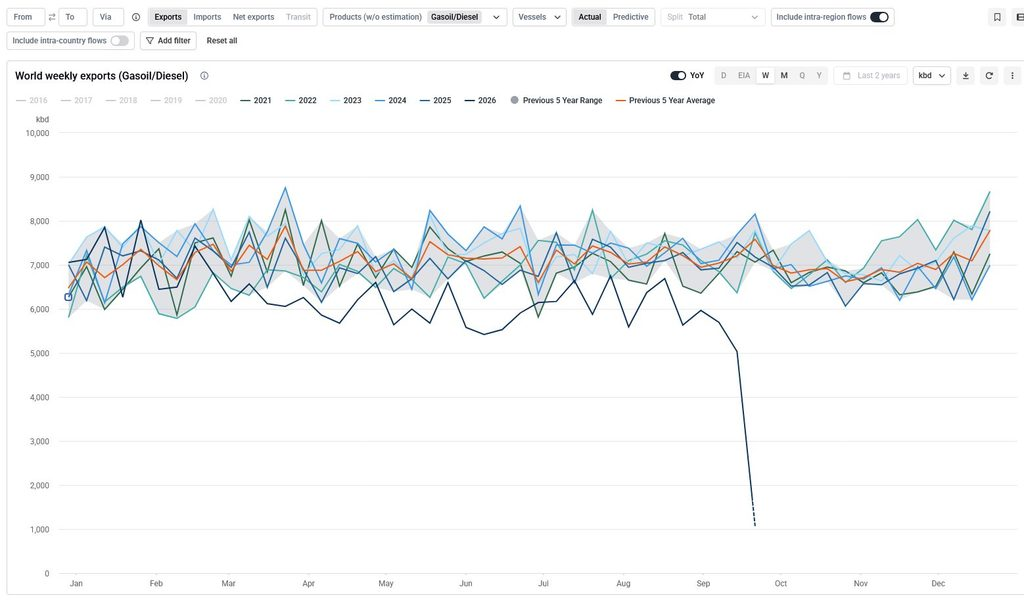
Damaged refineries and disrupted shipping are squeezing finished fuel. More crude oil cannot immediately replace missing diesel.
Australia’s international diesel benchmark averaged US$185 a barrel in the week to September 16, more than double its pre-conflict February level.
Washington could add another constraint.
Representative Tim Burchett has proposed two diesel export-control bills: one imposing a temporary ban until January 2027, another triggering restrictions when the national average price reaches US$5 a gallon.
These are proposals. No enacted US diesel export ban was identified as of September 21.
The administration is also divided on the economics. Interior Secretary Doug Burgum said restrictions were unlikely to lower consumer prices and could trigger retaliation.
The stakes extend well beyond America. S&P Global put September US diesel export activity at about 1.7 million barrels a day, as reported on September 15. Restricting those flows would push overseas buyers toward alternative cargoes, increasing competition for the Asian fuel Australia relies on.
Australia’s buffer needs careful interpretation.
The latest 31-day figure is national cover, not diesel reserved for mining. The government’s stockholding methodology includes eligible fuel in pipelines and vessels within Australia’s exclusive economic zone, plus refinery feedstocks counted as finished-product equivalents. Some still require processing or delivery.
National diesel stocks under that framework averaged 3.304 billion litres in the June quarter. No current, comprehensive public figure was found for fuel held specifically at mines.
Individual buffers can be much smaller. In March, AMEC warned that some smaller miners had only five days of diesel supply. That was a warning about particular operators, not today’s industry average.
Deliveries continue. Canberra reported 3.6 billion litres of fuel contracted to arrive over the next four weeks on September 19. It also extended the temporary 20% reduction in minimum petrol and diesel stockholding requirements through January 2027, conditional on suppliers delivering more fuel and prioritising regional supply.
For miners, the cost exposure is already measurable.
Australian mining consumed approximately 9.6 billion litres of diesel in FY2023–24. At that consumption rate, every sustained A$0.10-a-litre increase represents roughly A$960 million in additional annual expenditure, before changes in consumption, contracts or hedging. That covers mining broadly, not critical minerals alone.
Copper producer AIC Mines offers a direct example. Diesel accounts for about 10% of production costs, although its FY2026 report said Eloise continued receiving its full contracted allocation.
Costs can therefore rise well before production stops.
For critical-mineral investors, the implication is practical: assess usable fuel stocks, daily consumption and delivery reliability alongside grade and project financing. A secure mineral deposit still needs a secure supply of fuel to become production.