

China’s Ministry of Commerce enacted Announcement No. 18, adding nine medium and heavy rare earth elements and their compounds to a controlled export list, enforcing licensing and customs scrutiny.
The following minerals, elements, and related materials are now covered under China’s new export-control regime:
- elements:
- Holmium (Ho)
- Erbium (Er)
- Thulium (Tm)
- Europium (Eu)
- Ytterbium (Yb)
- super-hard materials
- rare earth equipment + raw and auxilary materials
- medium and heavy rare earths
- lithium-battery and graphite anode materials
- overseas rare earth items
- rare earth technologies
Within days, Beijing escalated further — announcing additional port fees on U.S. ships starting October 14, effectively expanding its trade coercion beyond minerals.
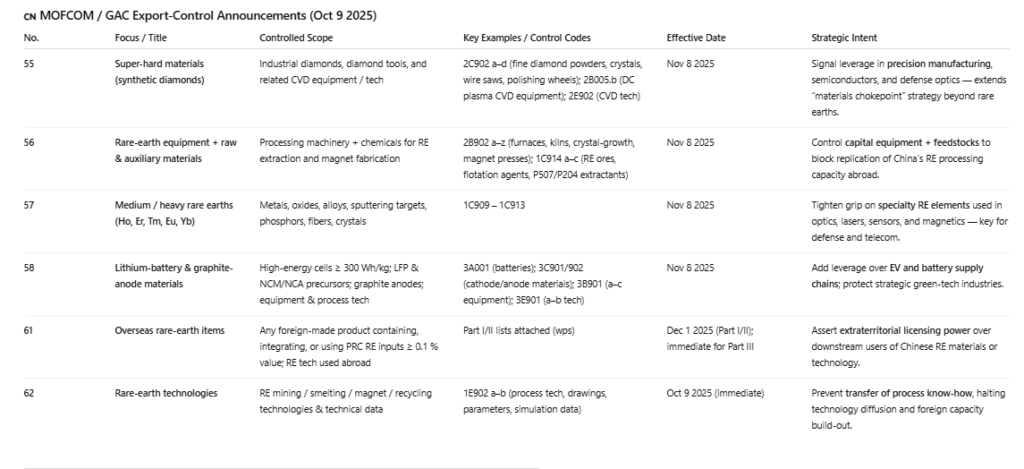
Announcement No. 18
China now requires exporters to secure dual-use licenses when shipping samarium, gadolinium, terbium, dysprosium, lutetium, scandium, yttrium, and their oxides, alloys, or compounds. Goods lacking proper classification may be held at customs.
Beijing frames the controls as safeguards for national security and alignment with export control law. But analysts see a geo-economic motive: reinforcing leverage over global supply chains in critical minerals.
Port Fees: Escalating the Pressure
Starting October 14, U.S.-owned, -flagged, or U.S.-built vessels at Chinese ports will face port fee surcharges. Chinese-operated vessels docking in U.S. ports will similarly see levies — proposals suggest fees could exceed $1 million per voyage for large container ships.
Chinese ports will charge 400 yuan (~$56) per net tonnage, rising to 640 yuan in April 2026 and 880 in April 2027. U.S. ships entering China ports will be charged 400 yuan per net tonnage from October 14.
This pairing of export licensing and shipping fees signals that China is broadening its toolkit for trade pressure — not just minerals but logistics.
Ripple Effects on Supply Chains
- Export compliance delays (license processing times stretched to 2–3+ months) are already dragging delivery schedules in semiconductor, automotive, and defense sectors.
- The port fees raise the cost baseline for U.S.–China trade, especially for heavy or bulk shipments. For sectors reliant on cross-Pacific shipping (e.g. EV magnets, rare earth alloys), this adds a new expense layer.
- Select U.S. automaker suppliers reportedly received six-month licenses, possibly as a relief valve to avoid wholesale disruption.