
📌 Key Takeaways
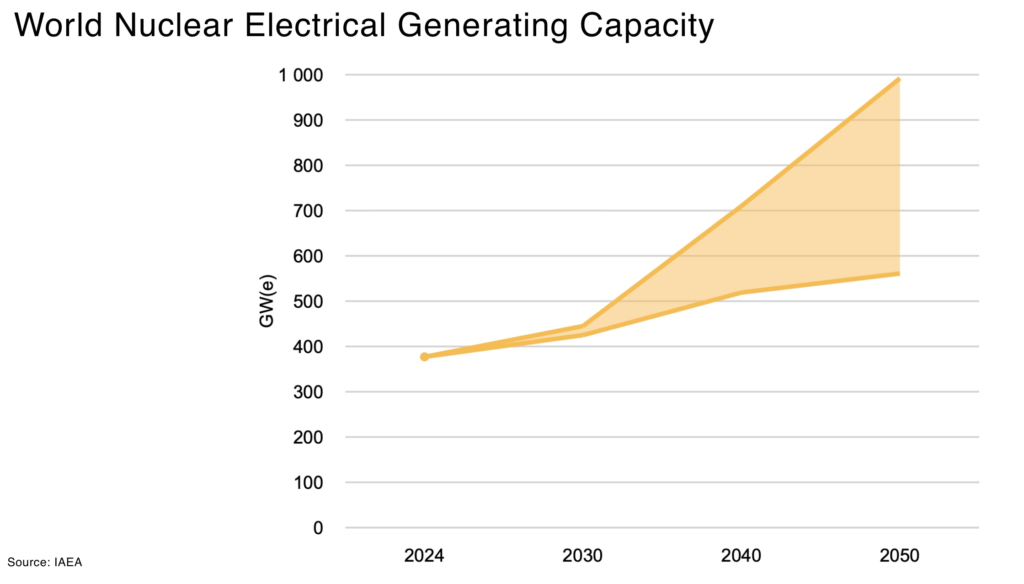
- Global nuclear capacity stood at 377 GW across 417 reactors in 2024.
- By 2050, IAEA projects 561 GW (low case, +50%) to 992 GW (high case, +160%).
- SMRs could account for 24% of new capacity in the high case, just 5% in the low case.
- To hit the high-case, annual build must rise from 5.9 GW/year (past five years) to ~26 GW/year.
Global nuclear power could nearly triple by 2050. That’s the headline from the International Atomic Energy Agency’s latest projections, which now see installed capacity rising from today’s 377 GW across 417 reactors to almost 1,000 GW in a bullish scenario. Even under a more conservative pathway, capacity still rises by about half, reaching 561 GW by mid-century.
In 2024, six new reactors with 6.8 GW of capacity were connected to grids, while four reactors totaling 2.9 GW were retired. Construction began on nine new units, adding a planned 10.1 GW. Net nuclear output reached 2,670 TWh, about 8.7% of global electricity production, slightly down from 2023’s share. The IAEA’s 45th annual Energy, Electricity and Nuclear Power Estimates paints two very different futures: one driven by aggressive investment and policy support, the other by more incremental gains.
The High-Case Ambition
Achieving the high-case requires a break from historical trends. Two-thirds of the world’s reactors are more than 30 years old, and 40% have operated for over 40 years. In the high-case, lifetime extensions mean only 81 GW of today’s fleet retires by 2050. That would demand 615 GW of net new capacity, averaging ~26 GW per year.
By contrast, the low-case assumes more retirements — 156 GW by 2050 — leaving just 184 GW of net additions. The difference between the two paths largely reflects how fast new technologies, especially Small Modular Reactors (SMRs), can scale.
SMRs as the Swing Factor
- High-case: 24% of new build from SMRs (~162 GW).
- Low-case: 5% (~16 GW).
- SMR adoption hinges on regulatory harmonization, financing, and cost competitiveness.
The delta between high and low scenarios is effectively an SMR story — and by extension, a policy and capital markets story.
Policy, Technology, and Demand
The IAEA stresses that policy environments will determine which scenario plays out. National climate commitments, financing models, supply chain resilience, and workforce development are decisive. The COP28 pledge by 31 countries to triple nuclear capacity by 2050 underscores growing political support. Major tech companies and multilateral lenders are also showing new willingness to finance nuclear projects, including advanced designs.
Meanwhile, electricity demand is set to double by 2050, while total final energy use falls 3% thanks to efficiency gains. Nuclear remains the second-largest source of low-carbon electricity, providing 9% in 2024, behind hydro at 15%. Wind and solar together accounted for 15% last year but remain intermittent, underscoring nuclear’s role as stable baseload.
Regional Outlook
- North America: Capacity could more than double to 236 GW (high-case) or fall slightly to 98 GW (low-case) by 2050, depending on retirements and license renewals.
- Europe: Diverging trends; Western Europe sees declines, while Eastern Europe expands.
- Asia: Central and Eastern Asia are projected to drive most growth, with China already operating 57 reactors totaling 53 GW in 2024 and planning significant additions.
- Africa & Middle East: Still small today, but nuclear starts to feature in long-term plans, with Western Asia and Africa each potentially adding tens of GW by 2050. (IAEA RDS-1/45, 2025).
Why It Matters
For investors, the IAEA’s high-case scenario means unprecedented demand across the nuclear value chain: uranium mining, enrichment, SMR developers, component suppliers, and plant services. Policymakers face a binary choice: enable reforms that accelerate build-out, or risk falling into the low-case trajectory where nuclear’s global share of electricity falls from 8.7% in 2024 to 7.2% by 2050.
The forecast comes just as The Sprott Physical Uranium Trust, the world’s largest holder of the heavy metal, now has about 70 million lb. of uranium after it bought 450,000 lb more in September as nuclear energy’s strategic value comes into sharper focus.
The window for decision is narrow. Extending existing reactors and fast-tracking SMRs will determine whether nuclear grows into a pillar of the clean energy transition — or drifts into stagnation.