

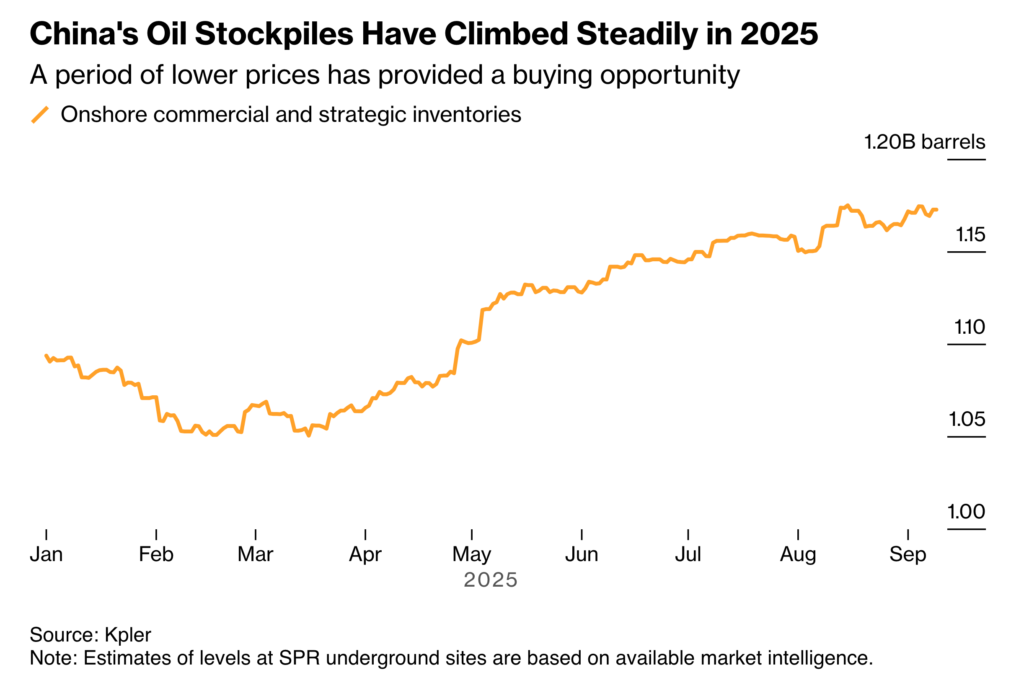
China has built one of the largest crude stockpiles in the world, with onshore inventories now estimated at around 1.4 billion barrels, including some 355 million barrels held in its strategic petroleum reserve (SPR).
The scale of accumulation is striking: in the first eight months of 2025, surplus crude—imports plus domestic output minus refinery runs—averaged nearly 1 million barrels a day, with August alone topping that level. China’s surplus crude (imports + domestic output minus refinery runs) has averaged ~990,000 barrels per day (bpd) in the first eight months of 2025.
🇨🇳 Why is China stockpiling so much oil?
- Price Window: China’s stockpiling comes against a backdrop of softer oil prices and rising geopolitical risks. Benchmark Brent fell from above $80 a barrel in January to lows under $60 by May, creating a buying window that Beijing moved quickly to exploit. At the same time, refinery throughput has lagged import flows, leaving excess barrels that can only be diverted into storage. China is taking advantage.
- Refinery Constraints Refinery throughput is increasing but still can’t keep up with inflows. That creates a bottleneck—crude comes in faster than it’s processed, so it gets stored.
- Strategic and Geopolitical Hedging Strategic motives also loom large. Tensions in the Middle East, sanctions on Russian and Iranian shipments, and a more fragmented global supply chain have all heightened China’s desire to expand its energy buffer. Analysts at LSEG expect the country’s SPR build to continue well into the first half of 2026.
🛢️ What does this mean for oil markets?
For oil markets, the implications are twofold. First, the accumulation acts as a hidden price support. Even when demand signals are weak, Chinese buying absorbs supply and reduces downward pressure on benchmarks. Second, the opacity of China’s reserve data adds volatility. Traders have no clear line of sight into how much crude is being absorbed, or when Beijing might shift from building inventories to drawing them down.
That lack of transparency is already distorting markets. Discounts on sanctioned barrels—particularly from Iran—are widening as storage tanks in key hubs such as Shandong fill up, while refiners weigh quotas and logistics bottlenecks. The uncertainty feeds into forecasts, with analysts forced to hedge their supply-demand balances around one of the biggest blind spots in global energy.
📌 Conclusion
Bottom line: China has already put away a huge barrel count, with surplus crude flows of ~1 mbpd sustaining the build. For global oil markets, the accumulation acts like a hidden buffer—supporting prices, increasing uncertainty, and altering where value can be derived (storage, transport, flexibility).