

Gold has shattered records, surging past $3,500 per ounce in early September 2025, propelled by expectations of a U.S. Federal Reserve interest rate cut, persistent geopolitical tensions, and aggressive central bank buying.
This milestone marks an inflection point for miners, investors, and policymakers as gold asserts itself as the leading safe-haven asset amid global economic uncertainty.
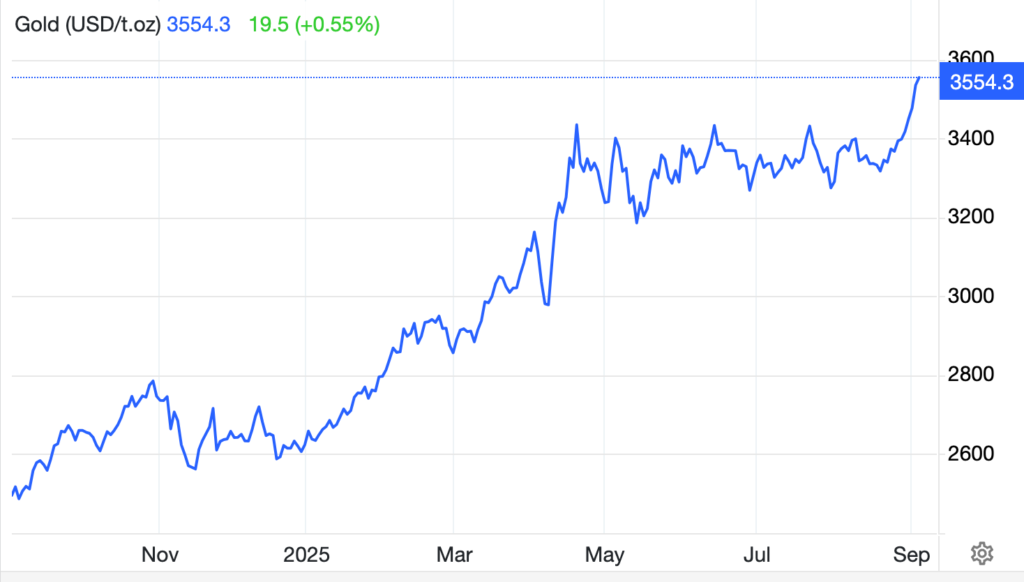
Why Gold Broke $3,500
- The Federal Reserve is expected to announce a 25-basis-point rate cut later this month, with the probability near 90% according to market tools, driving investors toward gold as lower rates weaken the U.S. dollar and reduce yields on competing assets.
- Central banks around the world are accumulating gold at unprecedented rates to diversify away from the dollar, further amplifying demand.
- Heightened geopolitical risks, including new tariffs and ongoing conflicts in Ukraine and the Middle East, are pushing investors to hedge with gold.
- The metal’s non-yielding nature thrives in environments plagued by inflation, currency uncertainty, and declining confidence in U.S. economic leadership.
Mining Sector Implications
- Gold producers are enjoying record profit margins, with all-in sustaining costs (AISC) averaging $1,250–$1,350 per ounce and margins exceeding $2,000 at current prices.
- Free cash flow generation is strong, enabling miners to accelerate debt reduction and boost dividends for shareholders.
- A surge in mergers and acquisitions is underway, as companies use their higher-valued equity to acquire assets and expand reserves.
- Exploration budgets have swelled, enabling juniors and developers to ramp up discovery and advance projects previously considered marginal in lower-price environments.
Structural Drivers and Outlook
- Supply remains tight, with global gold mining output rising just 1% in 2025 despite price incentives, due to grade decline, regulatory hurdles, and long development timelines for new mines.cruxinvestor+1
- Secondary supply through recycling has shown a 10–15% yearly increase, but cannot offset surging primary demand amid macro uncertainty.discoveryalert
- Analysts see further upside: forecasts suggest gold could test $3,700 by year-end, and potentially reach $4,000 in 2026 if current trends persist.tradingnews+2
Bottom Line
Gold’s historic climb above $3,500 reflects a confluence of global risks, shifting central bank strategies, and policy uncertainty. Miners are reaping enormous rewards, capital is flooding into all tiers of the gold sector, and investors are rediscovering gold as unmatched protection in a volatile, dollar-weakened world.